Whats new in EventCatalog - March 2026

Welcome to the monthly update for EventCatalog. March was a big month. We shipped governance capabilities, field-level intelligence, a redesigned schema explorer, a new Miro integration, AI-assisted flow creation, and upgraded the entire platform to Astro 6.
- Architecture Change Detection
- Schema Insights - Trace Fields Across Your Architecture
- Field-Level Usage Tracking
- Message Usage Examples
- Flow Wizard Skill
- OpenAPI Consumer Services
- EventCatalog Miro App v2
- Astro 6 and Platform Upgrades
- Other project improvements
Architecture Change Detection
A service starts consuming your OrderPlaced event. No ticket. No Slack message. No email. You find out weeks later when something breaks downstream.
Architecture Change Detection turns your catalog into an active monitoring system. It compares your EventCatalog across git branches, detects when services start or stop producing or consuming messages, and notifies your teams automatically.
You define governance rules in a governance.yaml file at the root of your catalog. Each rule specifies what to watch, what conditions to trigger on, and where to send notifications.
This is designed for service owners who want to know the moment someone starts depending on their messages, platform teams who need to catch breaking changes before a PR merges, and operations teams who want an audit trail of every dependency change.
We also added the schema_changed and message_deprecated governance triggers, and support for a fail action type so you can gate CI/CD pipelines on governance rules.
You can read more about Architecture Change Detection in our release blog post here.
Schema Insights - Trace Fields Across Your Architecture
As your architecture grows, schemas multiply. An OrderPlaced event gains fields. A PaymentProcessed event reuses some of those same fields. A CustomerUpdated command redefines one of them with a slightly different type. Nobody notices until a consumer breaks.
Schema Insights indexes every field from every message schema in your architecture and makes them searchable, traceable, and verifiable from a single page.
Available at /schemas/fields in your catalog, Schema Insights gives you:
- Field search and filtering across every message in your architecture
- Type conflict detection that flags when the same field name has different types across messages
- Interactive traceability graphs showing how a field connects to messages and services
- A redesigned Schema Explorer with a modern layout and dark mode support
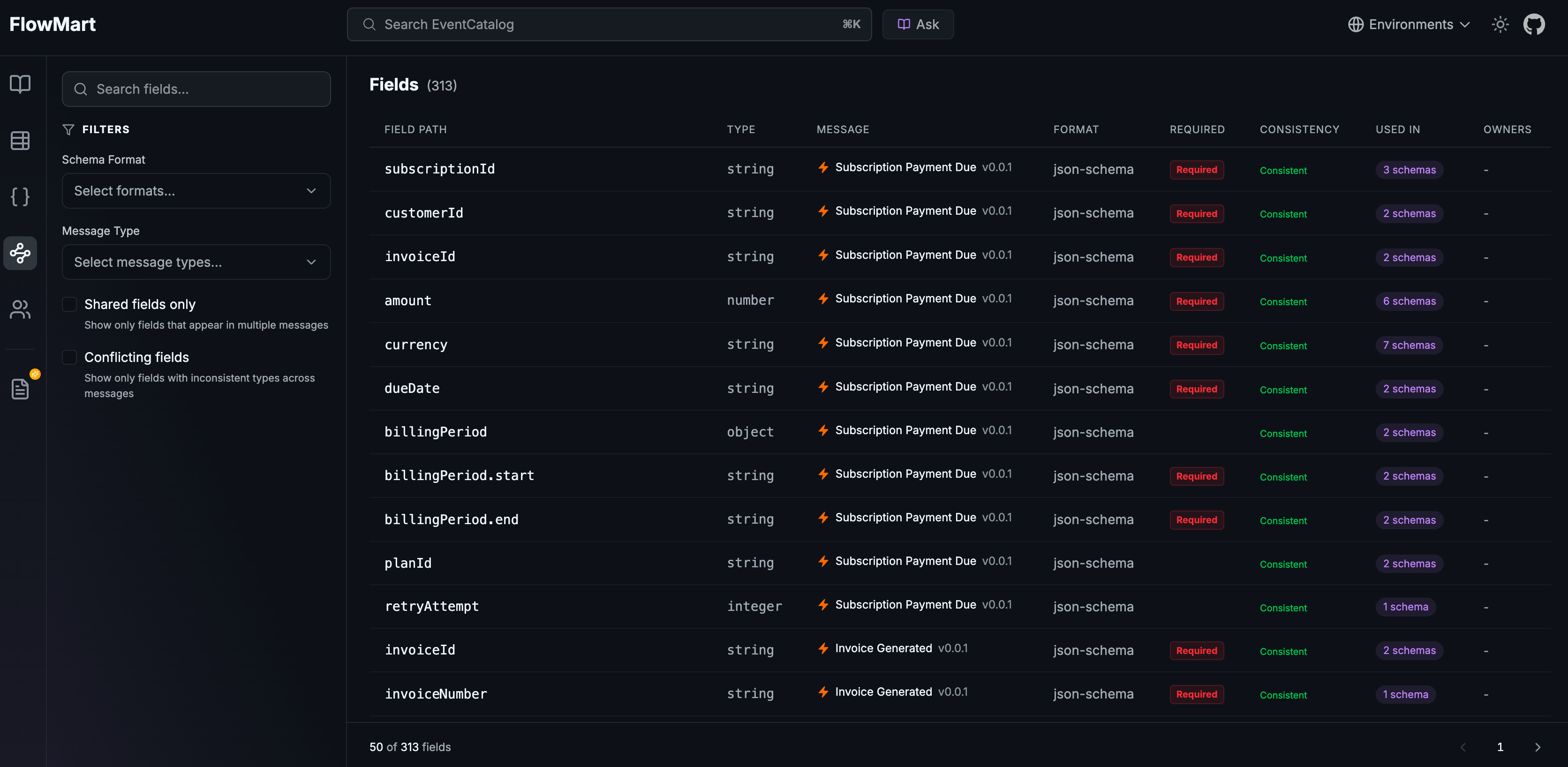
You can read more about Schema Insights in our release blog post here.
Field-Level Usage Tracking
EventCatalog already tells you which services consume a message. Now it can also tell you which specific fields they use.
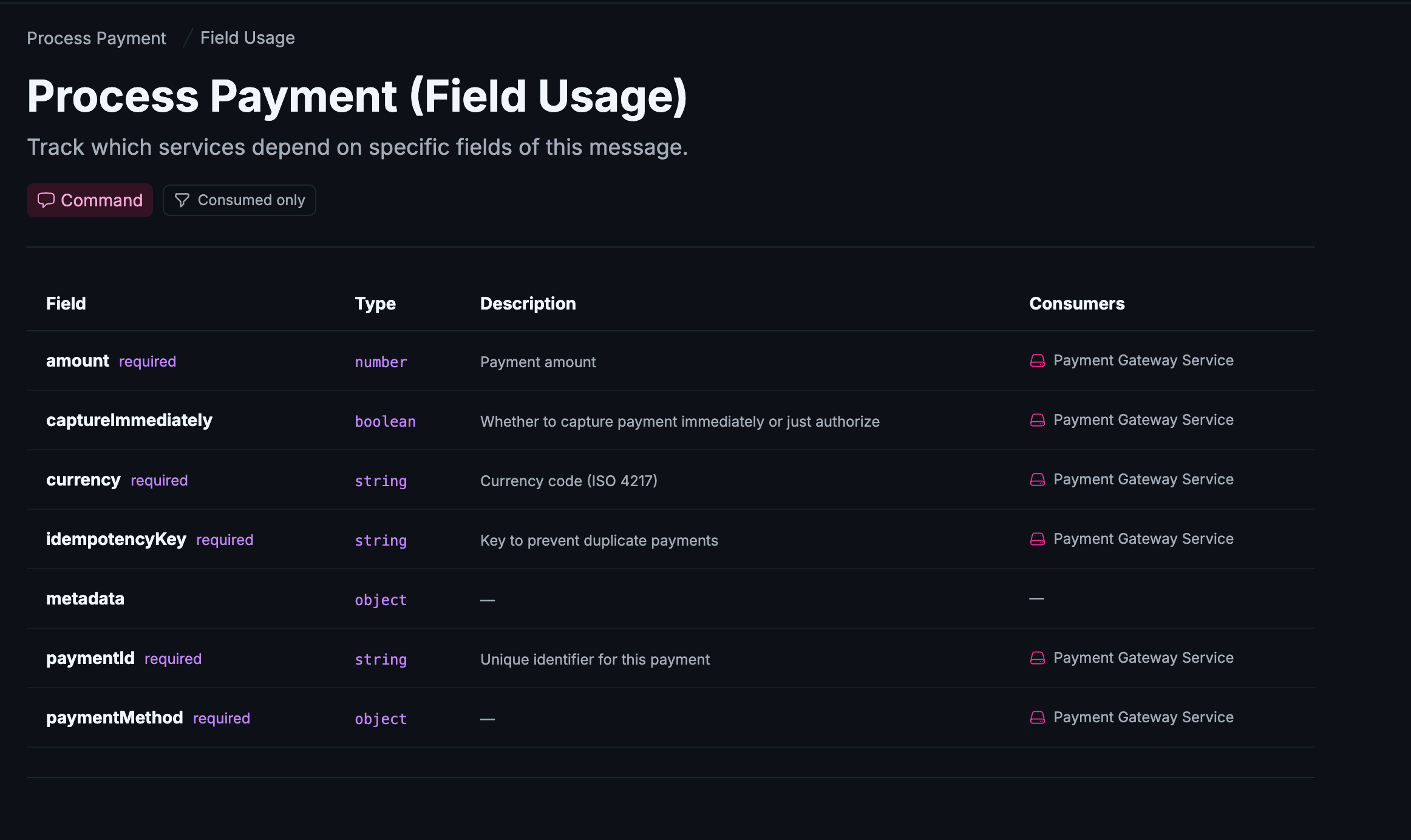
When consumers declare which fields they depend on, the message page gains a Field Usage view showing every schema property alongside the services that use it. This makes it much easier to understand the blast radius of a schema change. If you're about to remove a field or change its type, you can see exactly who depends on it.
Field usage is opt-in. Add a fields array to any entry in the receives pointer of a service, and EventCatalog surfaces it automatically.
You can read more about field-level usage in our release blog post here.
Message Usage Examples
A schema tells you the shape of a message. An example shows you how it can be used. Schemas are necessary. Examples are what people actually reach for when they're writing a consumer, debugging a failed event, or onboarding to a service they've never touched.
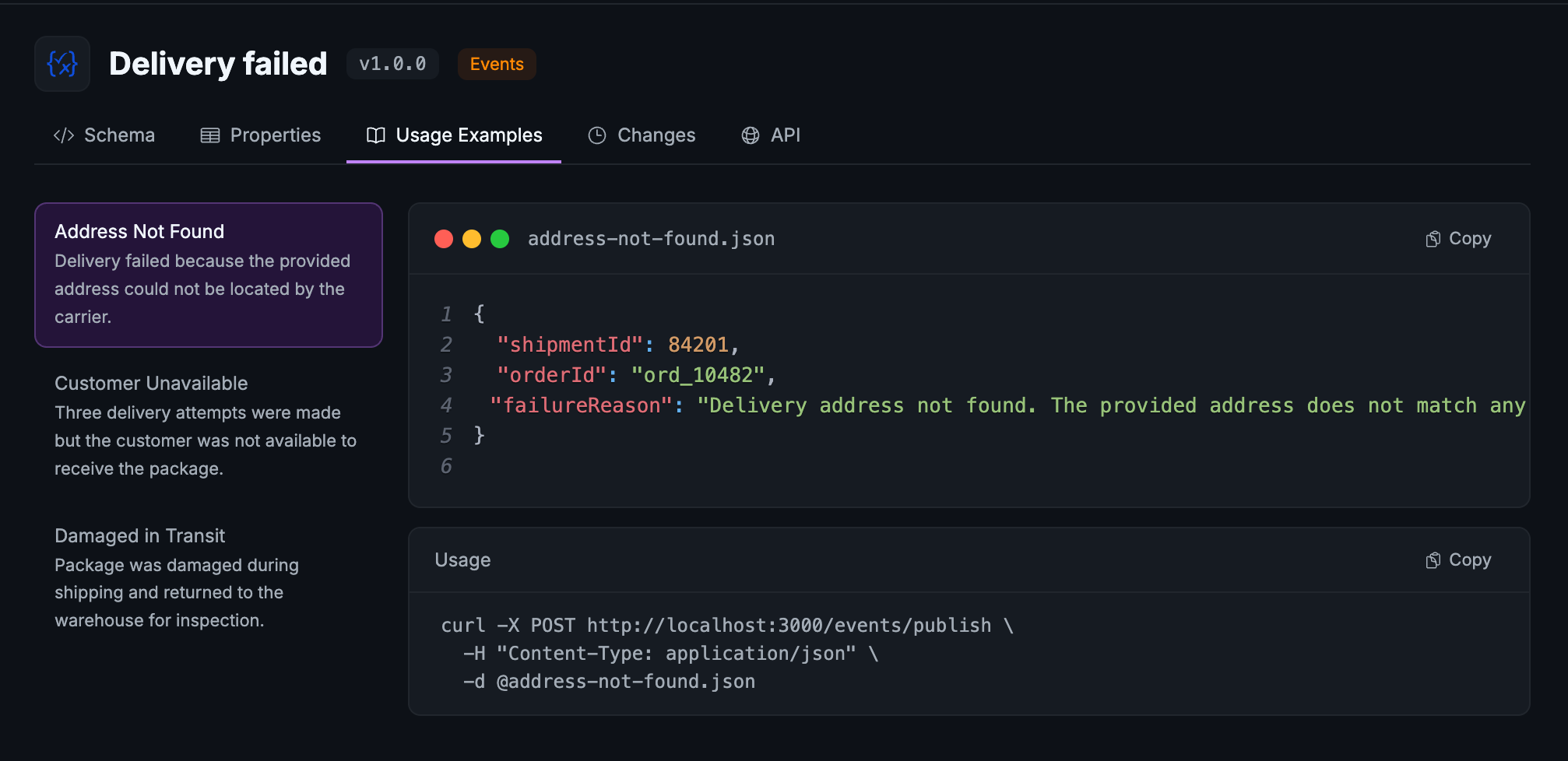
Drop JSON, YAML, XML, Protobuf, or any format your messages use alongside your schemas. EventCatalog renders them with syntax highlighting under a new Usage Examples tab in the Schema Explorer. Each example can carry metadata to describe the scenario it represents, a standard order, an international order, a failed payment.
You can read more about message examples in our release blog post here.
Flow Wizard Skill
Flows are one of the most popular resources documented in EventCatalog. They let you document end-to-end business workflows, giving your team the bigger picture of how everything connects. But creating them meant writing YAML by hand.
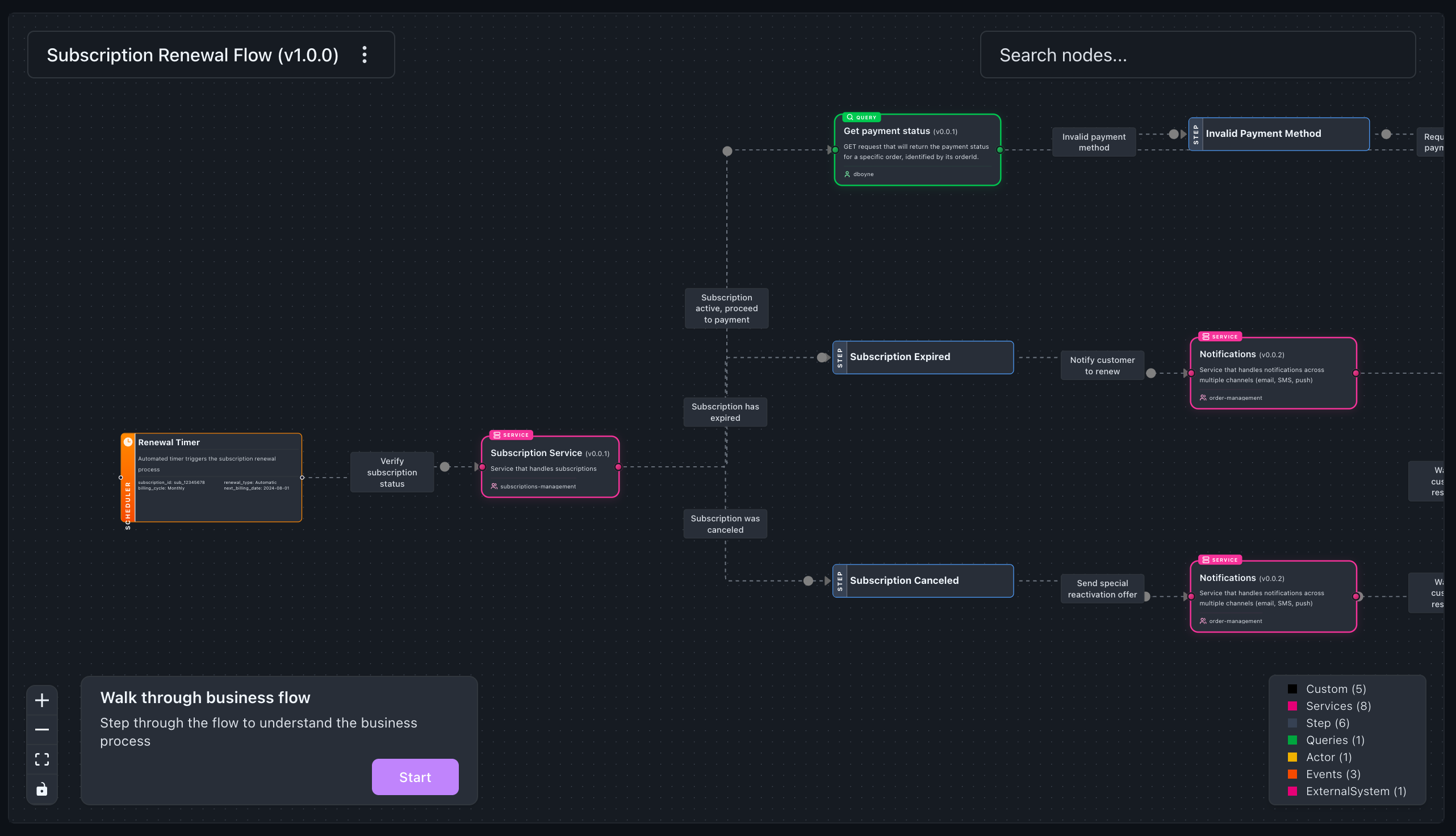
The new flow-wizard skill lets you describe your workflow in plain language, and your AI agent builds the flow for you. It scans your existing catalog resources, walks you through each stage of the workflow, and cross-references services, events, and commands you already have.
Whether you're a product owner, architect, or developer, if you can describe a business workflow you can now document it. No YAML knowledge required.
You can read more about the flow wizard in our release blog post here.
OpenAPI Consumer Services
Understanding who owns an API is useful. Understanding who consumes it is what makes the documentation actually actionable.
The OpenAPI generator now supports a consumers array on each service configuration. Each entry defines a downstream service that calls endpoints produced by that API, with optional route-based filtering to scope which endpoints it cares about.
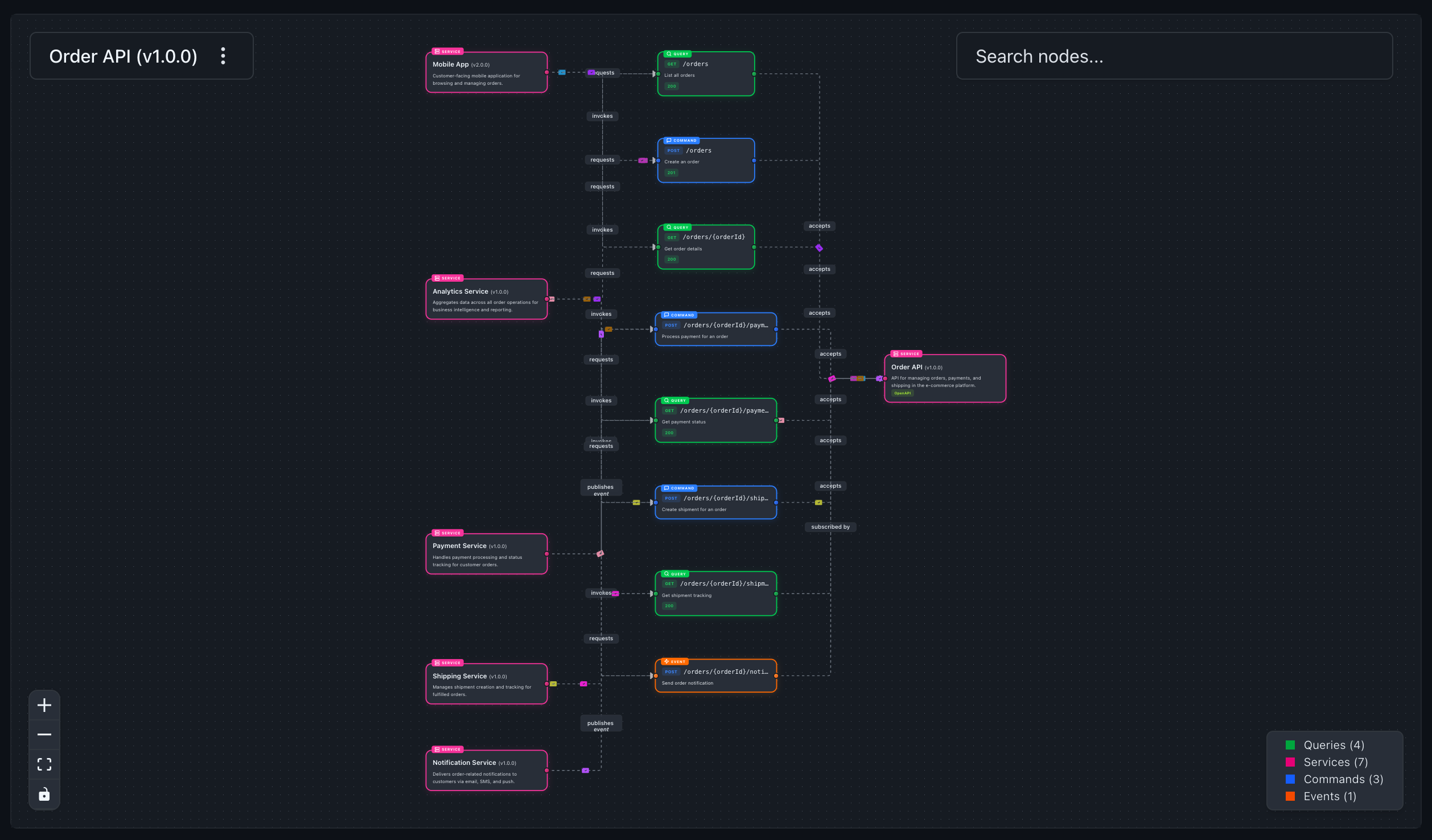
This means your architecture diagrams and documentation now show the full producer-consumer picture for your REST APIs, not just the owner.
You can read more about OpenAPI consumer services in our release blog post here.
EventCatalog Miro App v2
Every team has the same problem. The architecture lives in one place and the diagrams live in another. The Miro board from the last event storming session doesn't match what's actually running.
The EventCatalog Miro App v2 turns your documentation into interactive, collaborative design artifacts, and brings your design decisions back into the catalog when you're done.
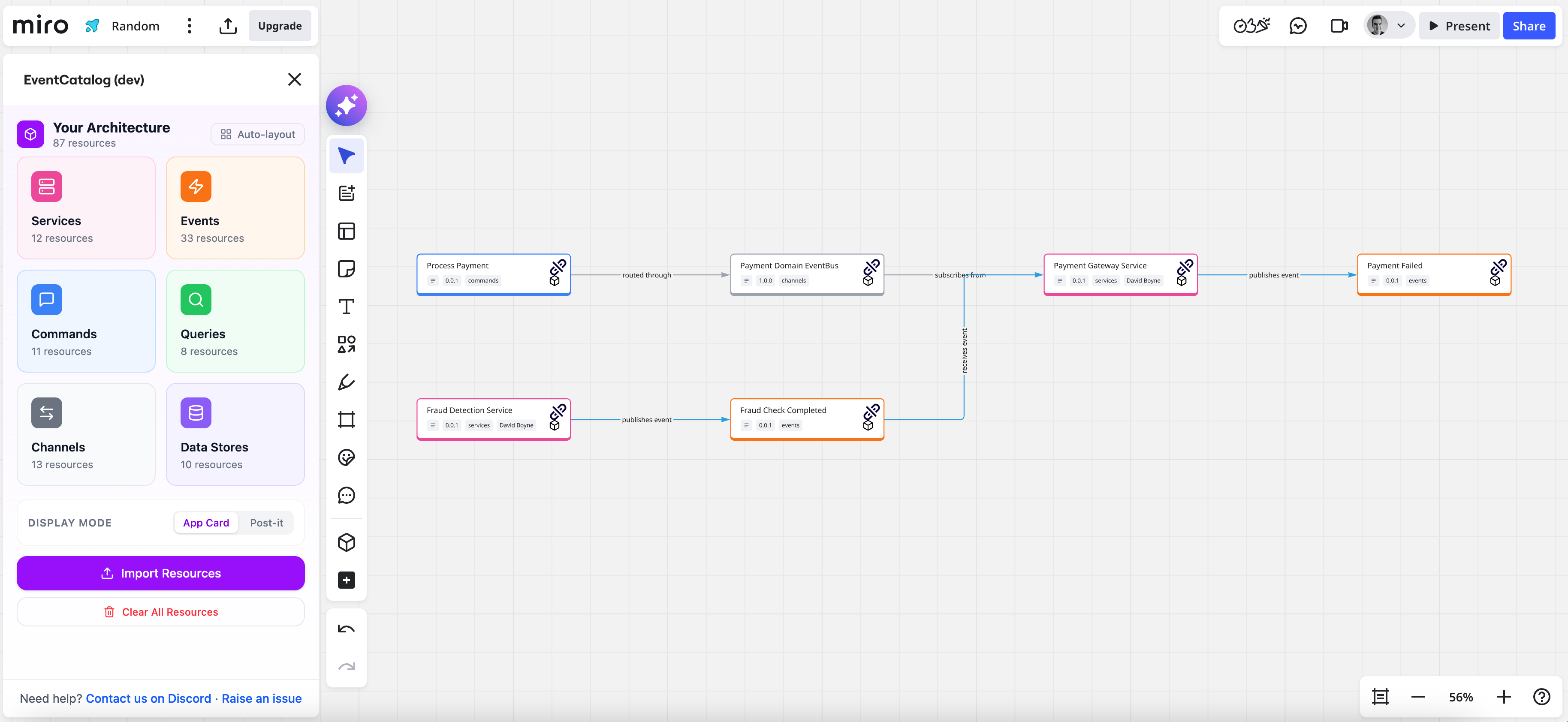
The v1 integration embedded Miro boards into doc pages. V2 flips the direction. Your documented architecture flows into Miro, you design on top of real data, and the results flow back out. You can:
- Browse, search, and drag your full catalog onto a Miro board
- Drag services with their full dependency graphs
- Edit resources inline and create new draft resources on the board
- Navigate between connected resources with smart connectors
You can read more about the Miro App in our release blog post here.
Astro 6 and Platform Upgrades
We upgraded EventCatalog to Astro 6, Zod 4, Vite 7, and Vitest 4. This is a significant platform upgrade that improves build performance and keeps EventCatalog on the latest tooling.
As part of this upgrade, we also replaced better-sqlite3 with sql.js (WASM), removing the need for native binary compilation. This means fewer installation issues, especially in CI environments and Docker containers.
To upgrade, run:
npm install @eventcatalog/core@latest
Other project improvements
- Added
eventcatalog exportcommand for exporting your catalog programmatically - SDK now supports entities, containers, and flows in
dumpCatalog - SDK changelog helper methods for programmatic access to changelogs
- Added channels section to service sidebar
- Entity map visualiser now available for services
- Flows now support nested directories and work across domains/services
- Added analytics integrations: GA4, GTM, and PostHog
- Support for
governance.ymlin addition togovernance.yaml - Improved generated README for new EventCatalog projects
- Default template events now include usage examples
- Fixed: circular refs in AsyncAPI spec rendering
- Fixed: fields explorer crash with nullable JSON Schema types
- Fixed: fields index build failing when catalogs have no messages
- Fixed: auth behind reverse proxy (trustHost defaults to true)
- Fixed: SSR compatibility for visualiser, schema/fields pages
- Fixed: sidebar navigation losing sync with custom base path
- Fixed: semver comparison for version sorting
- Fixed: schema API returning empty response in SSR mode
- Fixed: generator continues running when one generator fails
What's coming in April?
If you have any questions or want to join our community exploring EventCatalog and event-driven architecture feel free to join us!