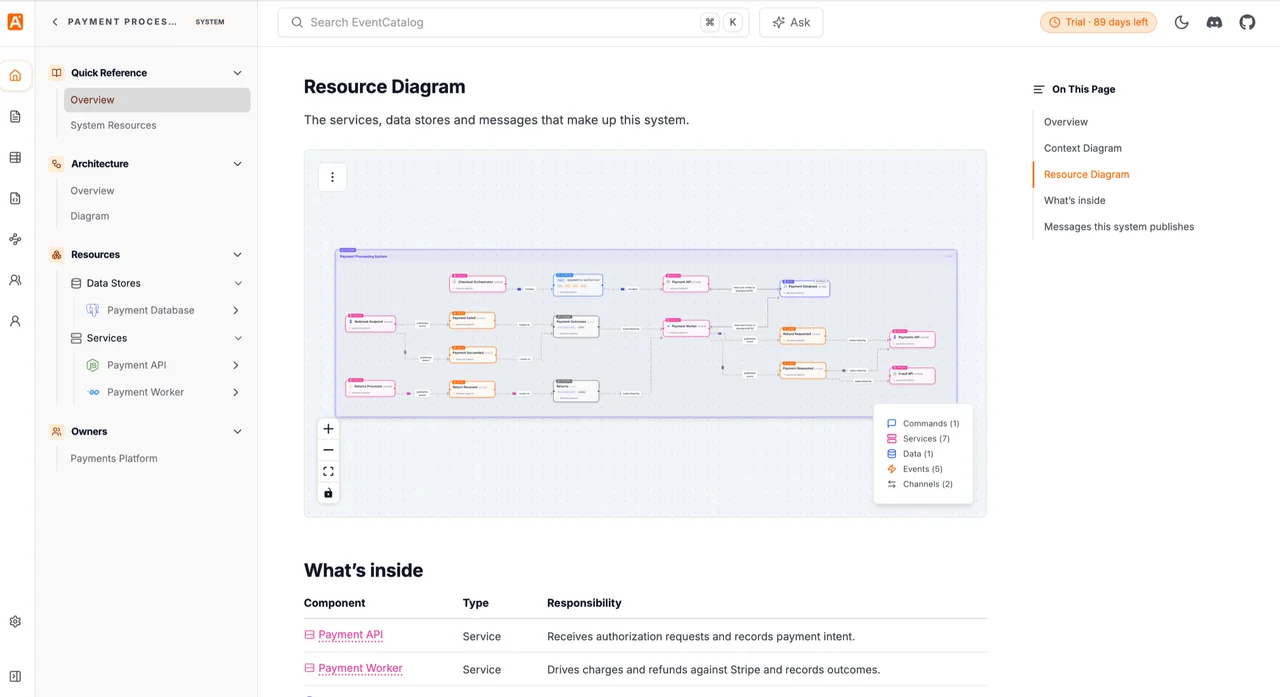


Architecture primitives, not pages.
In distributed systems, if you can't find it, it doesn't exist. Every part of your architecture gets its own page, owner and relationships, so teams can reason about change before it breaks something.

Find what exists. Find who owns it.
One place to search your architecture, from the domain down to a single field in a schema.
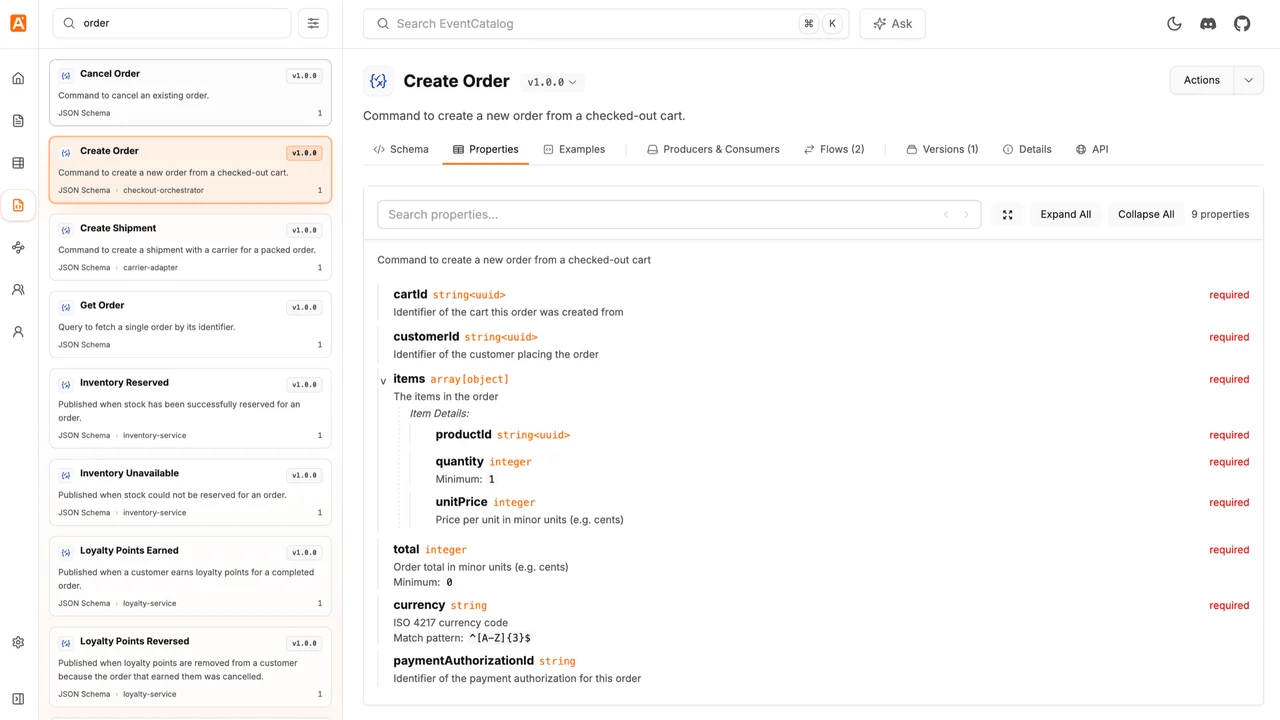
Type “order” and see every command, event and query that matches, with the service that owns it.
Every page shows who owns it, so questions reach the right team first time.
Developers find schemas, architects trace dependencies and product teams follow business flows.
Any spec, any schema, with the context around it.
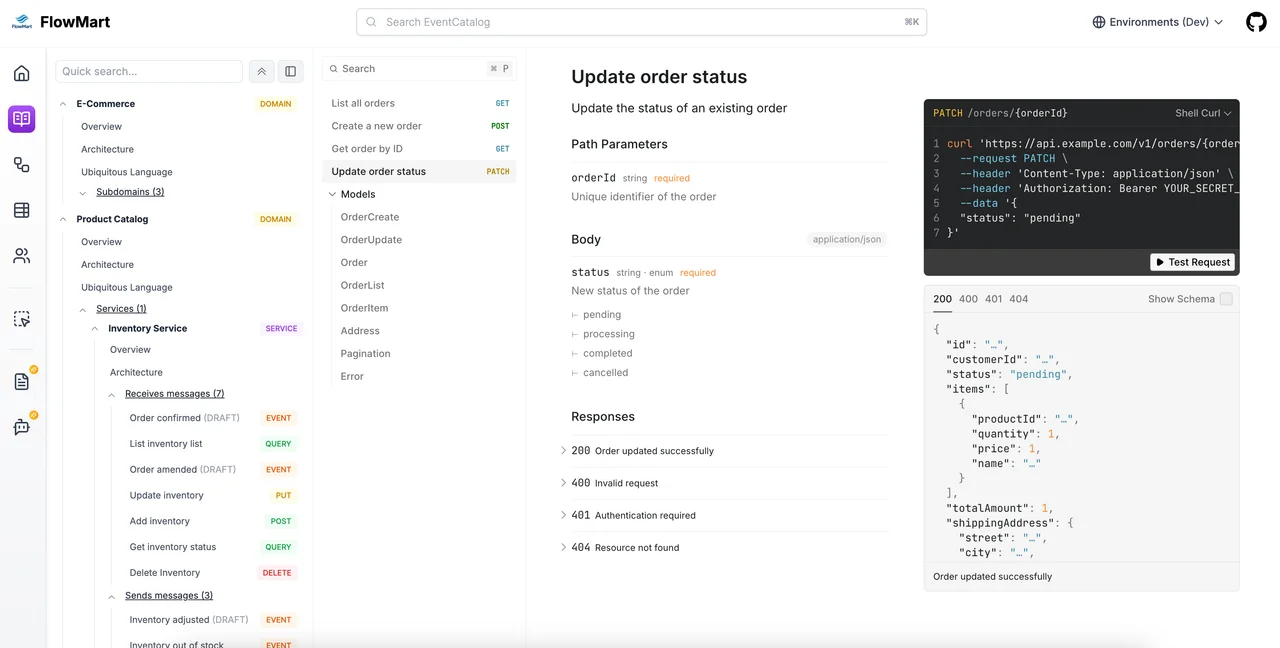
Specifications describe the shape of your APIs and messages. EventCatalog adds what they leave out.
OpenAPI, AsyncAPI, GraphQL, Avro, Protobuf and JSON Schema, each wrapped with ownership, relationships and diagrams.
Every version is kept, so you can compare releases and see when a breaking change arrived.
Specs from different repos, teams and registries show up in one catalog, assigned to a domain and an owner.
ADRs, runbooks and RFCs, next to what they describe.
Bring your team's documents into the catalog and link each one to the resources it affects. No more hunting across Confluence, Notion and old repos.
Every public event carries a version, and breaking changes ship as a new version.
Step-by-step guide for releasing and rolling back the Payments Service.
Proposal for standardising API versioning across every service.
Turn architecture decisions into checks.
Your team agreed how the architecture should look. Fitness functions check that it still does, so a change that crosses a domain boundary or adds one dependency too many is caught in review, not six months later.
Write each rule as a TypeScript function that reads your catalog with the EventCatalog SDK. No new query language to learn.
Keep catalog-wide standards at the root, and let each domain team keep its own rules next to its domain.
Run the checks locally or in CI. A change that breaks a rule fails the build, and points at the resources that broke it.
Ask your documentation anything.
Your catalog is a structured graph, so AI answers from real relationships, not guesses. Ask in the catalog with EventCatalog Assistant, or from your IDE through the MCP server.
 Claude
 OpenAI
 CursorAny MCP clientYour agentconnected to EventCatalog MCP
›
Document one domain today.
Start with a single domain in Markdown, or generate it from your specs. Free for organisations under $10M.