Give every team a shared
understanding of your architecture
Your architecture lives in wikis, diagrams and people's heads. EventCatalog brings it into one place, where teams can document, visualise and explore it together.
Self-hosted · 40,000+ catalogs created
 Motorway
 AWS
AWS Nike
Nike GOV.UK
 Flipdish
 Eurostar
 EverQuote
 PayPoint
 PayFit
 Worldpay
 Airtime
 Booksy
 NHS
NHS Costco
 Deel
Deel American Logistics
 Prisma
 Mazda
MazdaThe knowledge exists. It’s just scattered.Ownership in spreadsheets. Diagrams in Miro. Schemas in registries. Context in people’s heads. Nobody can see the whole system.
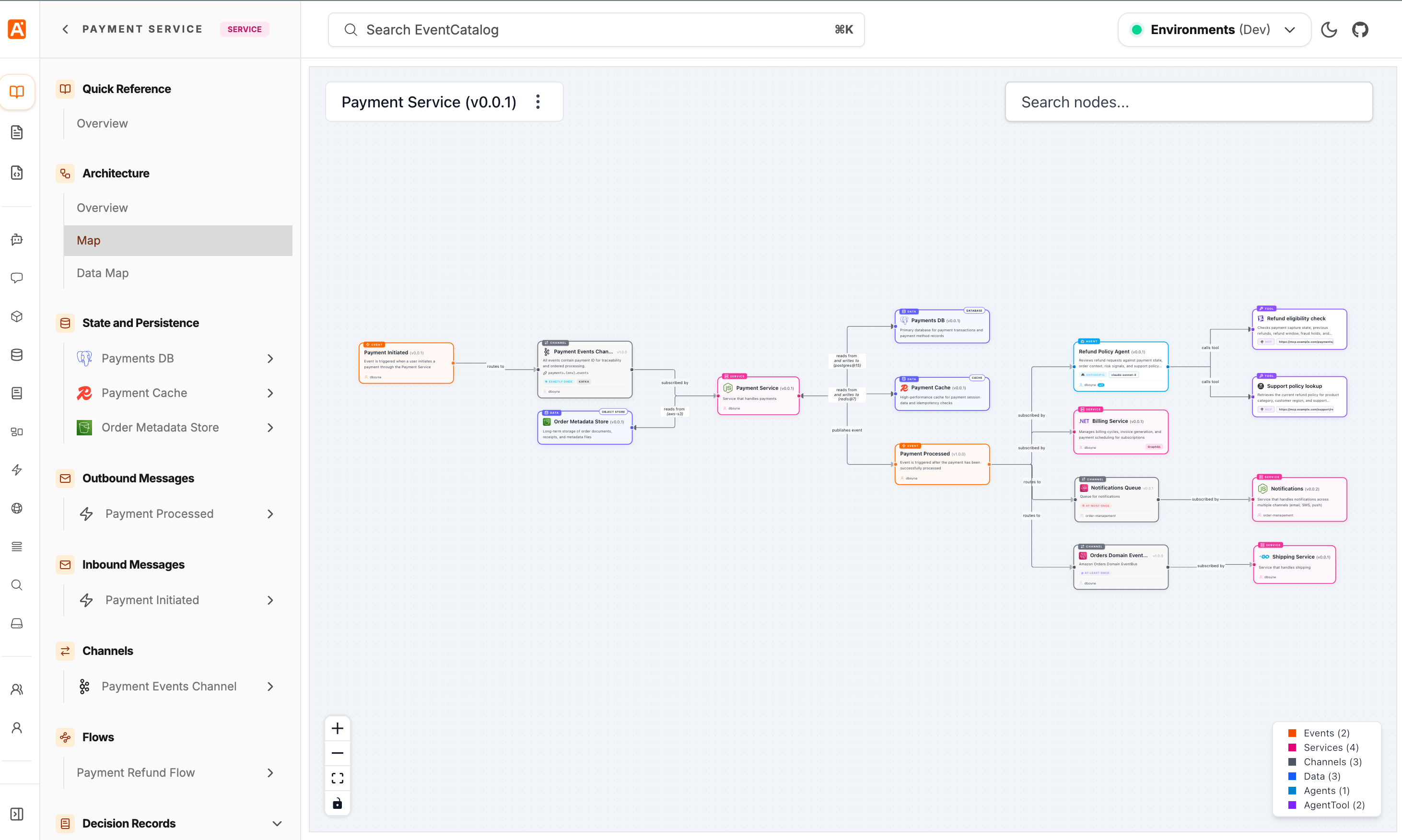
Understand your architecture in one connected model. Bring domains, systems, services, messages, APIs, owners and dependencies together so teams can see what exists and how it connects.
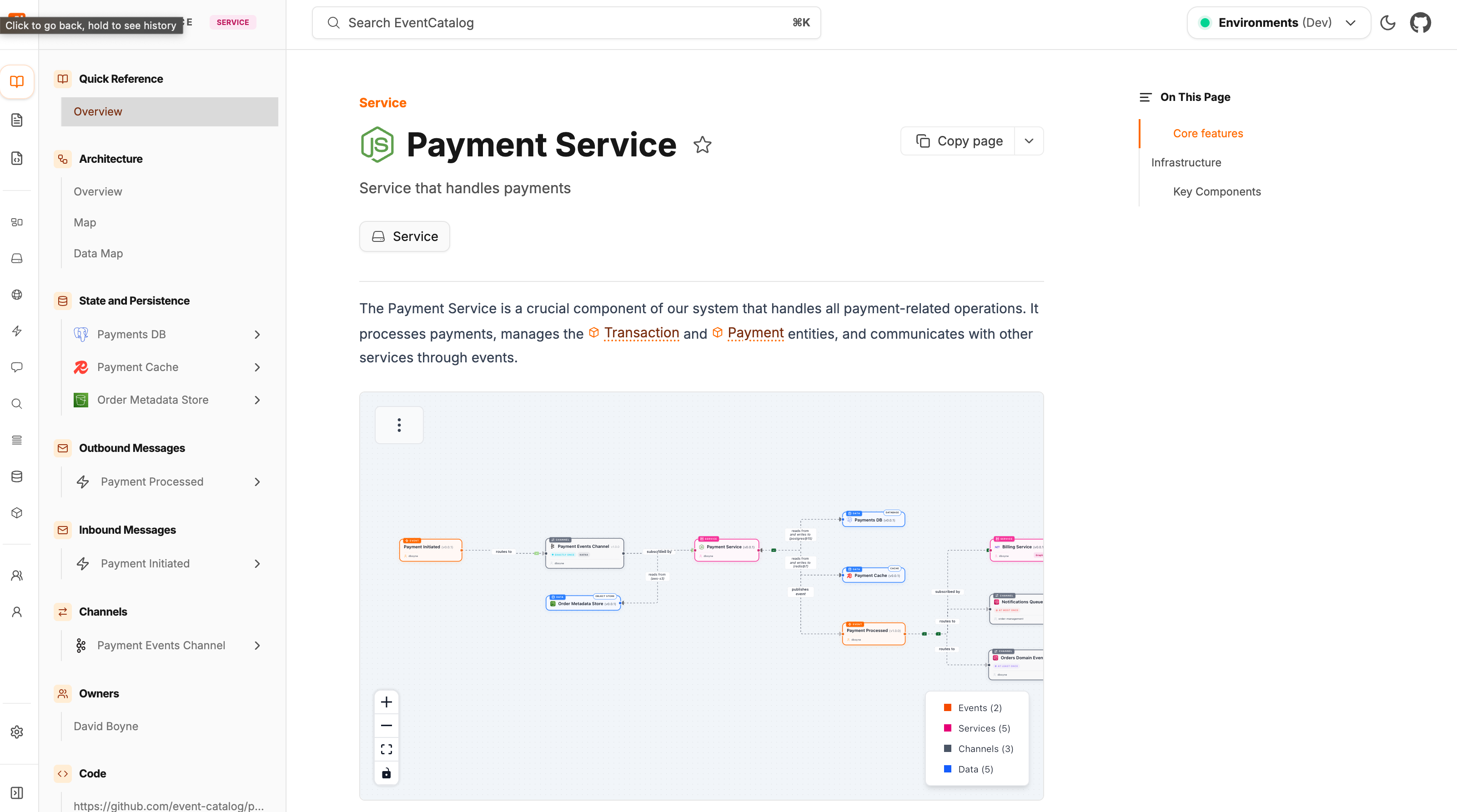
Building blocks, not blank wiki pages. Document your domains, systems, services and messages as connected resources.
Attach schemas, specifications, decisions and owners to each resource, so teams find the why and who without asking around.


See how everything fits together. Stop digging through docs to piece the system together. Start with the domains, zoom into services and messages, and get the right detail at the right time.
Orchestrates checkout: reserves stock, takes payment, creates the order.
The source of truth for orders and their lifecycle.
Takes payment for orders and processes refunds.
Picks, packs and ships confirmed orders.
Entry point for checkout.
ordering-platform
Runs the checkout saga.
ordering-platform
Creates and tracks orders.
ordering-platform
PostgreSQL · orders
ordering-platform
Domains, systems and actors. The context: who uses your systems, which domain each one belongs to, and how they relate to the rest of the business.
Start with the domain view, then zoom into systems, services, and the messages they exchange.
Document workflows like placing an order as flows. See every step, the services behind it, and which team owns each part.
Plan what's next, together. Design changes on a live canvas in EventCatalog Studio, starting from the services and messages you already document. Your team and your AI agents work on it with you, and the decision stays on record.
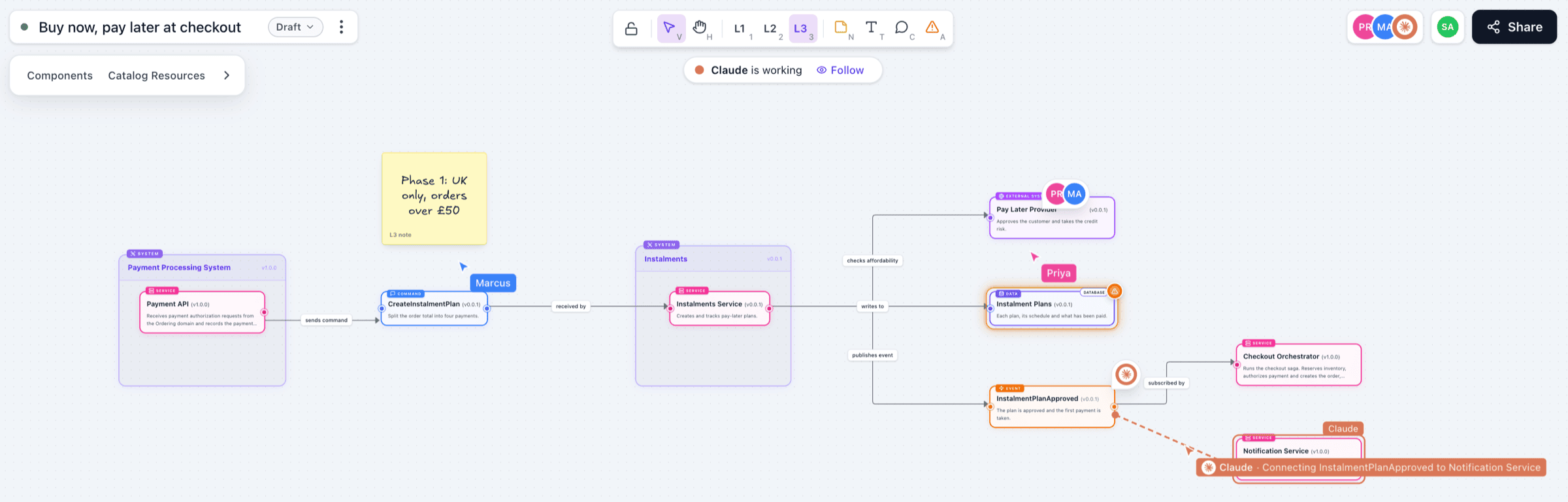
Everyone on a canvas sees each other's pointers and edits. Comment on a node, flag a risk, and mark the design proposed or accepted.
Connect Claude, ChatGPT or Cursor through the MCP server. Agents add resources from your catalog and connect them while you watch.
Documentation you can actually trust. Generate your catalog from OpenAPI, AsyncAPI and schema registries, and update it from every pull request, so what you read is what's running.
 AsyncAPIorders.yml
 OpenAPIpayments.yml
 Schema registries+ more
 Your codepull requests
 OpenAI
 Cursor
Plug EventCatalog into the CI/CD pipelines and processes you already have, with integrations, generators and the SDK.
On every pull request, the EventCatalog Agent updates the affected docs and opens a pull request for you to review.
Your agents are guessing. Give them context. Agents can read your code, but not your architecture. EventCatalog tells them what a change touches, who owns it and why it was built that way.
 ClaudeEventCatalog connected
EventCatalogshowResource
Orders Service accepts PlaceOrder and listens for PaymentTaken. It publishes OrderCreated and OrderCancelled, which Fulfilment and Notifications consume.
Connect Claude, Cursor or any MCP client to the EventCatalog MCP server to query services, schemas and owners as you work.
Scope MCP servers to a domain or system so teams and AI tools get focused, trusted architecture information exactly when they need it.
Start with one team. Skip the Confluence sprawl. Scale when you’re ready.
Create your first catalogUsed by teams around the world.Self-host EventCatalog and keep full ownership of your architecture documentation and data.
Trusted by teams building complex systems.What architects and engineers say about EventCatalog.
With EventCatalog we now have a clear view of all events and schemas — and more importantly, we know who to reach out to when we want to consume data.
 Dennis BaertenFreelance Lead Engineer at NikeNike
Your architecture is a system. Document it like one.
Rolling out across many teams? Start with the Success Programme or see pricing.