Set up Breaking Changes with Azure DevOps
Run Breaking Changes in Azure Pipelines on your Azure Repos pull requests, from the EventCatalog Agents pipeline template. New to Breaking Changes? Read the introduction first.
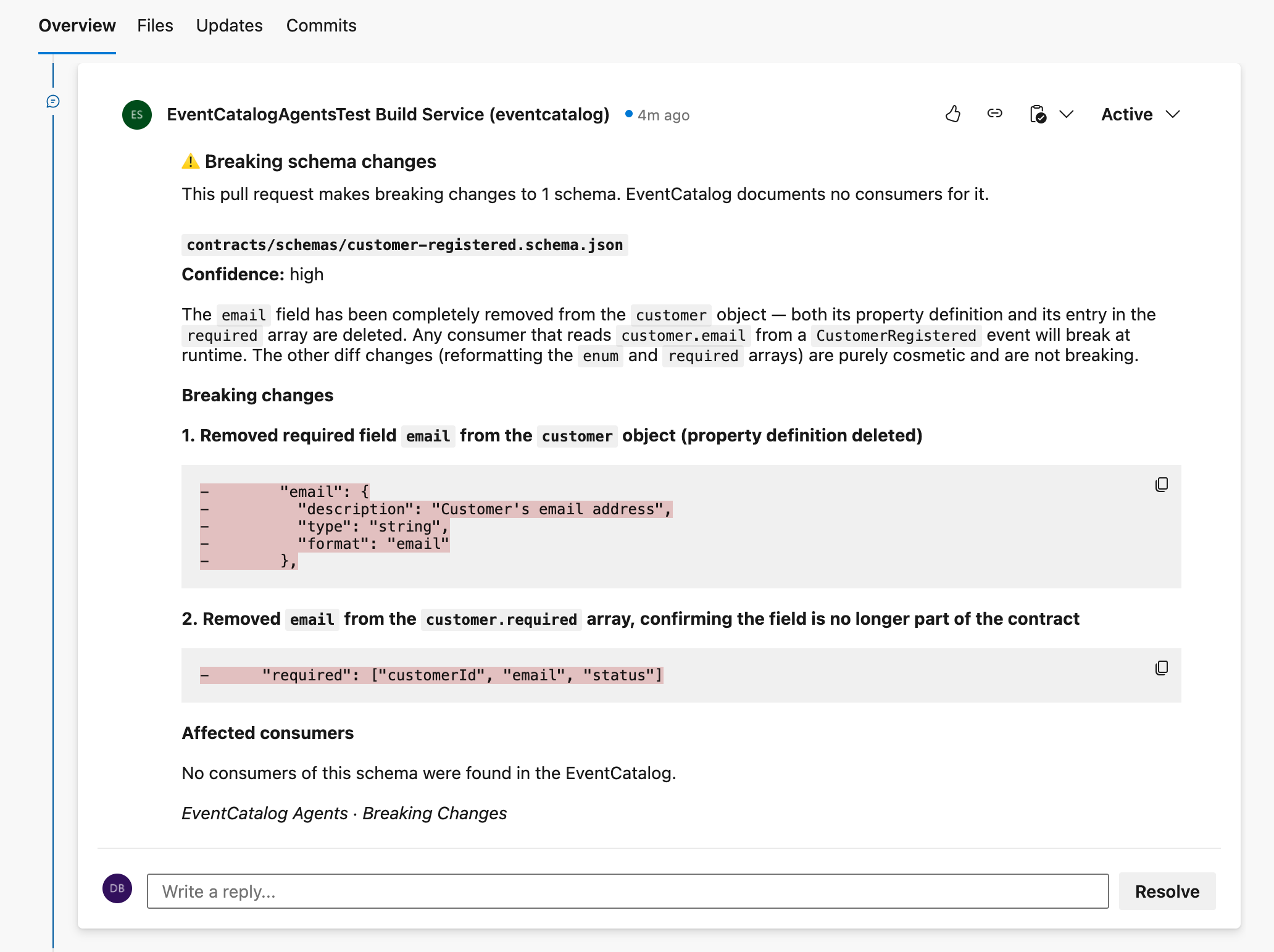
The agent runs from a build validation branch policy while the pull request is open, and comments in an active thread, so reviewers see it before the change merges:
Before you start
You need:
- An Azure DevOps organization with your source code in an Azure Repos Git repository (the source repository).
- An EventCatalog in an Azure Repos repository (the catalog repository), with the catalog at the root of the repository, and the consumers of your messages documented in it. It can be in another project of the same organization. Or keep it on GitHub.
- An API key for an AI model provider.
- Microsoft-hosted agents, or a self-hosted Linux agent with internet access. New Azure DevOps organizations have no free Microsoft-hosted agents until you request them, which usually takes a few days.
Setup
1. Add your model provider key
In Pipelines → Library, create a variable group named eventcatalog, and add your model provider key as a secret variable, such as ANTHROPIC_API_KEY (see models). Azure Pipelines passes secret variables to the agent only when you map them in the template's env parameter, as the pipeline below does.
2. Give the build service access
The agent uses the pipeline's own token (System.AccessToken), so you don't need a personal access token. The token belongs to your project's build service, <Project> Build Service (<Organization>). If your pipelines aren't limited to the current project, it's Project Collection Build Service (<Organization>) instead.
In Project settings → Repositories, select each repository, open Security, find the build service, and allow:
| Repository | Permissions |
|---|---|
| Source repository | Contribute to pull requests, to comment |
| Catalog repository | Read. The workflow never writes to it. |
The build service only appears in the list after the pipeline has run once. If your catalog is in a different project, also give the build service access to that project.
3. Add the pipeline
The template lives in the EventCatalog Agents repository. To use it, reference that repository as a resource. Azure Pipelines needs a GitHub service connection to read templates from GitHub. The repository is public, so any connection works. If you can't add one, copy the template instead.
Add this file to your source repository, and create a pipeline from it (Pipelines → New pipeline → Azure Repos Git → Existing Azure Pipelines YAML file):
trigger: none # runs from the build validation policy

resources:
  repositories:
    - repository: eventcatalog-agents
      type: github
      endpoint: github # the name of your GitHub service connection
      name: event-catalog/agents
      ref: refs/tags/v2
    - repository: catalog
      type: git
      name: Architecture/eventcatalog # your catalog repository: Project/Repo

pool:
  vmImage: ubuntu-latest

variables:
  - group: eventcatalog # holds ANTHROPIC_API_KEY

jobs:
  - job: breaking_changes
    uses:
      repositories: [catalog]
    steps:
      - checkout: self
        fetchDepth: 0
      - template: azure-pipelines/eventcatalog-agents.yml@eventcatalog-agents
        parameters:
          agent: breaking-changes
          catalogRepo: Architecture/eventcatalog
          catalogUrl: https://catalog.example.com # optional: links consumers to your hosted catalog
          env:
            ANTHROPIC_API_KEY: $(ANTHROPIC_API_KEY)
Replace Architecture/eventcatalog with your catalog repository, as Project/Repo, in both places.
- Keep
fetchDepth: 0. The agent needs the history to compare the pull request with its target branch, and new pipelines fetch only the latest commit by default. - Keep the
catalogresource anduses. They give the job's token access to the catalog repository, which the Protect access to repositories in YAML pipelines setting requires. It's on by default. Approve the pipeline's access to the repository on its first run.
4. Add build validation
In Project settings → Repositories → your source repository → Policies, open your main branch, and add the pipeline under Build validation:
- Trigger: Automatic.
- Policy requirement: Optional. The agent is advisory, and a failure such as a model provider outage shouldn't block a merge.
5. Check it works
Open a pull request that removes a field from a schema that a service in your catalog consumes. The agent comments in an active thread. Each push updates the same thread.
Run it with Code-to-Docs
If you also sync docs with your code, run both from one pipeline: Breaking Changes on pull request builds, and Code-to-Docs on the CI build after a merge. Add trigger: branches: include: [main], and give each job a condition:
jobs:
  - job: breaking_changes
    condition: eq(variables['Build.Reason'], 'PullRequest')
    # ... as above

  - job: code_to_docs
    condition: ne(variables['Build.Reason'], 'PullRequest')
    # ... agent: code-to-docs
Parameters
| Parameter | Required | Default | Description |
|---|---|---|---|
agent | Yes | Set to breaking-changes to run this workflow. | |
catalogRepo | Yes | Your catalog repository: Project/Repo (or Repo in the same project), or its URL. owner/repo for GitHub. | |
catalogRef | No | main | The catalog branch to read. |
catalogProvider | No | azure-devops | Where your catalog is hosted: azure-devops or github. |
catalogToken | No | $(System.AccessToken) | A token that can read the catalog repository. |
catalogUrl | No | The URL of your hosted catalog. The comment links consumers and owners to it. | |
model | No | anthropic/claude-sonnet-4-6 | The model the agent uses. See models. |
schemaExtensions | No | .json,.yml,.yaml,.avro,.avsc,.proto,.graphql,.gql | The file extensions treated as message schemas. See which files are checked. |
ignorePaths | No | Build and dependency folders | Comma-separated paths or glob patterns to leave out of the review. |
workspace | No | $(Build.SourcesDirectory) | The source checkout to compare. If a job checks out more than one repository, self moves to $(Build.SourcesDirectory)/<repo>: set this to match. |
agentsVersion | No | v2 | The EventCatalog Agents release to run. Keep it the same as the ref of the eventcatalog-agents resource. |
env | No | {} | Environment variables for the agent, such as your model provider key: { ANTHROPIC_API_KEY: $(ANTHROPIC_API_KEY) }. |
To pin an exact release, set both the resource's ref (for example refs/tags/v2.3.0) and agentsVersion: v2.3.0.
Use a catalog on GitHub
To keep your catalog on GitHub with your code in Azure Repos, set catalogProvider: github, set catalogRepo to owner/repo, and pass a GitHub token that can read the catalog repository from a secret variable, such as catalogToken: $(GITHUB_CATALOG_TOKEN). A fine-grained token needs only Contents: Read. You don't need the catalog repository resource or uses.
Use the template without a GitHub connection
Copy azure-pipelines/eventcatalog-agents.yml into your repository, or into a shared templates repository in Azure Repos, and reference it by path, such as template: templates/eventcatalog-agents.yml. Set agentsVersion to the release you copied it from. The template still downloads the agent from GitHub when it runs, so the build agent needs internet access, as it does for your model provider and npm.
Differences from GitHub
- The comment is an active thread. It counts towards the Check for comment resolution policy if you use one. Reruns update the same thread.
- Impact diagrams show as Mermaid source. Azure DevOps renders Mermaid only in wikis.
Troubleshooting
| Message | What to do |
|---|---|
Cannot find the commits to compare | Set fetchDepth: 0 on the checkout: self step. |
Could not fetch branch … | Give the build service Read on the catalog repository, and keep the catalog resource and uses in the job. |
failed (401): the token was not accepted | Your personal access token has expired, or lacks the Code scope. |
| No comment on the pull request | The pull request may have no breaking schema changes. If it does, give the build service Contribute to pull requests on the source repository. |
Azure DevOps Server
The agent uses Azure DevOps REST API version 6.0, which Azure DevOps Server 2020 and later support, so it should work on Azure DevOps Server too. We test with Azure DevOps Services. A full catalogRepo URL on Server must include the project: https://server/tfs/Collection/Project/_git/Repo.