Getting started
Hookdeck is an event gateway that provides serverless infrastructure, features, tooling to enable the full software development lifecycle of event-driven applications.
Using the EventCatalog Hookdeck plugin you can extract information from Hookdeck to gain further understanding of event sources, destinations, and flows within the Hookdeck platform.
Core Features
The Hookdeck plugin can provide you with the following features:
- ⭐️ Generate EventCatalog Services from Hookdeck Sources and Destinations
- ⭐️ Auto-generate EventCatalog Messages from Hookdeck Requests and Events
- ⭐️ Auto-generate EventCatalog Message Schemas from Hookdeck Requests and Events
- ⭐️ Provide insight into Hookdeck Filters by indicating Requests that are received by an EventCatalog Service but are not connected to destination Service.
How it works
EventCatalog supports generators. These are scripts or plugins that can be run to integrate with any external API, system or specification files. EventCatalog also provides an SDK to give developers easier access to their catalogs through custom scripts or generators.
The EventCatalog Hookdeck plugin queries the Hookdeck API to generate an EventCatalog visualization including Services and Messages. It also generates inferred Message schemas.
The plugin can either be used as a plugin within an EventCatalog instance or as a CLI configured to point to an EventCatalog instance.
Getting started
1. Install the plugin
npm i @hookdeck/eventcatalog-generator
2. Configure your generator in your eventcatalog.config.js file
/** @type {import('@eventcatalog/core/bin/eventcatalog.config').Config} */
export default {
  title: 'OurLogix',
  tagline: 'A comprehensive logistics and shipping management company',
  organizationName: 'OurLogix',
  homepageLink: 'https://eventcatalog.dev/',
  landingPage: '',
  editUrl: 'https://github.com/boyney123/eventcatalog-demo/edit/master',
  trailingSlash: false,
  base: '/',
  logo: {
    alt: 'EventCatalog Logo',
    src: '/logo.png',
    text: 'OurLogix',
  },
  docs: {
    sidebar: {
      showPageHeadings: true,
    },
  },
  generators: [
    [
      "@hookdeck/eventcatalog-generator",
      {
        hookdeckApiKey: process.env.HOOKDECK_API_KEY,
        domain: "Payments",
        connectionSourcedMatch: "payments-.*",
        processMaxEvents: 200,
        logLevel: "debug",
      },
    ],
  ],
};
3. Run the generate command
This command will run the generators in your eventcatalog.config.js file.
npm run generate
4. View your catalog
Run your catalog locally to see the changes:
npm run dev
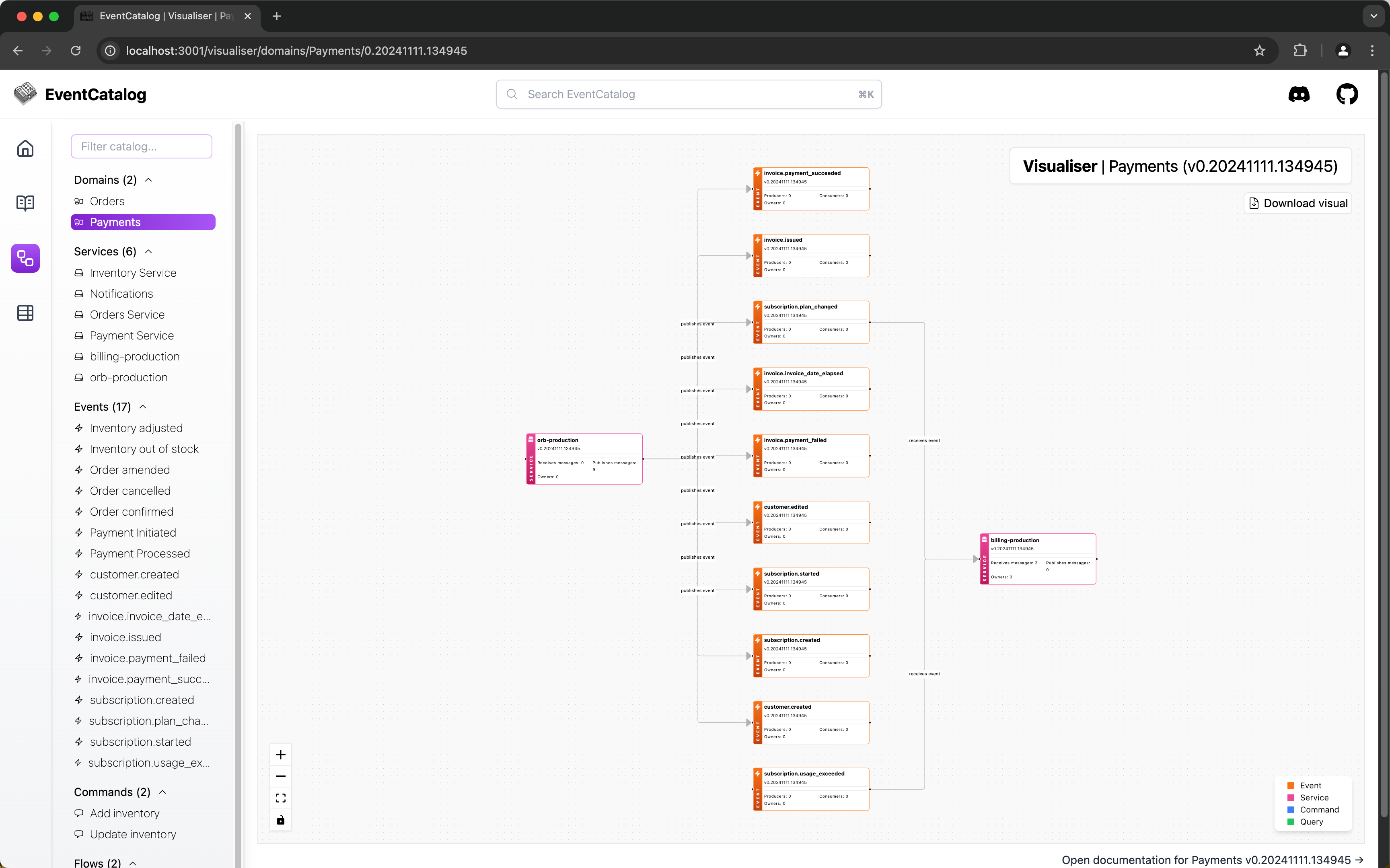
Hookdeck Concepts
Sources
A Hookdeck Source represents any service that makes an HTTP request to Hookdeck. The HTTP requests can be inbound events such as webhooks or asynchronous API calls.
Destinations
A Hookdeck Destination represents the destination for an event to be routed to. A destination can be connected to one or many Sources.
Connections
Connections in Hookdeck route an event from a Source to a Destination. Connections can reuse sources and destinations, allowing one event to be routed to multiple destinations.
Event lifecycle
The following represent different stages of the lifecycle of an event within Hookdeck:
- Requests: An HTTP request received by a Source URL defined within Hookdeck, such as a webhook.
- Events: An outbound event payload that Hookdeck has queued for delivery.
- Attempts: An HTTP delivery attempt to the URL defined by a Destination.
Features
Generate EventCatalog Services
The Hookdeck plugin generates EventCatalog Services from Sources and Destinations that are used within defined Hookdeck Connections. The Sources and Destinations that have Services created can be filtered using the connectionSourcedMatch configuration option which performs a regular expression match on the connection source name.
Auto-generate EventCatalog Messages
EventCatalog Messages are generated for Requests received by a Source and Events received by a Destination. The number of Hookdeck Request and Events to have EventCatalog Messages generated can be set using the processMaxEvents configuration option.
By default, the plugin search for a type or eventType property on the event payload to uniquely identify a Request or Event type. If the property cannot be found, each Request or Event is treated as a unique Message within EventCatalog.
Auto-generate EventCatalog Message Schemas
Hookdeck does not presently support schemas. Therefore, a Message schema can only be inferred from an event payload. The Hookdeck EventCatalog plugin generates inferred schemas for the first instance of an Event type and Request type it processes.
Provide insight into Hookdeck Filters
Hookdeck supports the ability to filter events based on header or body contents. This can result in Sources receiving Requests but not Events being generated. EventCatalog's visual representation help you identify where events are being entirely filtered out and not delivered to any destination service.
Commercial Use
This plugin is free to use for commercial use.
Source
https://github.com/hookdeck/eventcatalog-generator
Issues
If you have any problems or feature requests please raise them on GitHub: https://github.com/hookdeck/eventcatalog-generator/issues