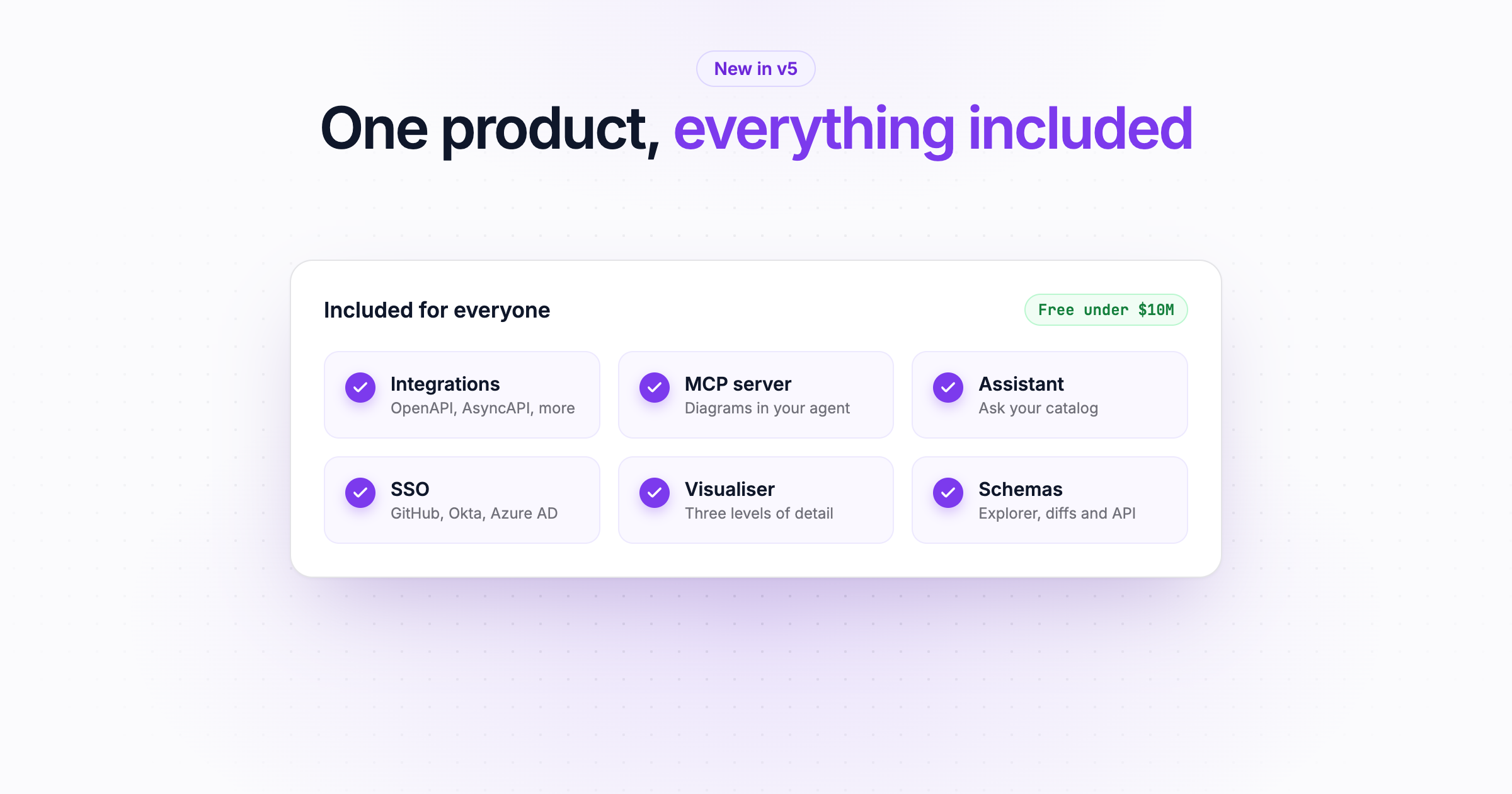
EventCatalog v5 brings diagrams with three levels of detail, flows grouped by domain, system or team, and your architecture inside your AI agent through the MCP server. Integrations are included in one product, with simpler pricing and a new licence model for the project. Here's what's changing and why.
EventCatalog started as an open source project. The idea was simple: document event-driven architectures in a way that doesn't go stale the week after someone draws the diagram. The community took it further than we ever expected. Today hundreds of organisations use it every month, from startups to banks, airlines and some of the biggest retailers in the world.
To make the project sustainable, we moved to an open-core model: the catalog free and open source, with paid plugins, integrations and enterprise features on top. It worked for a while, and it's the reason EventCatalog could become a full-time project. But AI is changing the ecosystem around EventCatalog, and the open-core model we have today no longer fits it.
So with EventCatalog v5, we're simplifying everything: one product, simpler pricing, and a new licence. EventCatalog stays free for individuals, open-source projects, education and organisations under $10M. Organisations above that pay by how many teams use the catalog, and every release becomes open source in the long run.
- v5 is one product. Integrations, the MCP server, the assistant and SSO are included. Federation is free for organisations that qualify for Free Use. On a paid plan, federation is Enterprise only.
- EventCatalog stays free for individuals, open-source projects, education, and organisations with under $10M in revenue and under $10M raised.
- Larger organisations buy a licence priced by how many teams use the catalog, from $5,995 a year. No seats, no per-resource fees, and AI agents are included.
- v4 stays MIT. Every v5 release becomes MIT four years after it ships.
New in v5
v5 also brings new ways to see and design your architecture. Each one has its own post:
- One diagram, three levels of detail. Every domain and system has one diagram. Start with what talks to what, then zoom into services, messages and channels.
- Your architecture diagrams, inside your agent. The MCP server shows your real diagrams and schemas inside Claude, ChatGPT and VS Code.
- See who owns every step of a flow. Group any flow by domain, system or team, as boxes or swimlanes.
- Design what comes next, together. EventCatalog Studio (v2) adds live canvases to your catalog. Plan changes with the resources you already document, review them with your team, and let AI agents edit with you.
The rest of this post explains what changes with the licence and pricing, and why.
From open source to open core
EventCatalog began as an MIT-licensed project, and the community shaped it: contributions, plugins, feedback, and teams using it in ways we hadn't planned for. As usage grew, so did the work. Open core gave the project a way to fund that work. Teams could use the catalog for free, and organisations that wanted automation and enterprise features paid for them.
That model got EventCatalog here, and we're grateful to every customer who made it possible.
How AI changed things
For the last couple of years, most paid features were automation: generators and plugins that keep the catalog in sync with your specs, brokers and schema registries. Then AI arrived. Today a team can point an agent at the SDK and write its own generator in an afternoon, so the paid part of EventCatalog got easier to replace every month.
At the same time, the catalog itself became more valuable. As agents write more of your code and more of your events, knowing what exists, who owns it and what breaks when it changes matters more, not less. Usage keeps growing year on year. The number of organisations paying hasn't kept up.
What EventCatalog charged for was worth less every month, and what was worth more was free.
The line between free and paid had also become hard to follow. Most of what teams needed was already free, and what was paid kept changing as the ecosystem moved. That made it hard for teams to know what they needed, and hard for buyers to make a purchase decision.
We thought long and hard about this
This wasn't a quick decision. We spent months on it, and we've tried to make it in the open: in the GitHub discussion, on calls with customers, and in conversations with many of you. Several parts of the final model changed because of that feedback.
These are the options we ruled out, and why:
- Per-seat pricing. A catalog is only useful if everyone can read it. Charging per person pushes teams to limit who sees it.
- Per-resource pricing. Charging for every event or service you document punishes exactly the behaviour EventCatalog should encourage.
- Pricing by company size. One team using EventCatalog at a global bank gets the same value as one team at a scale-up. Charging the bank ten times more for the same thing isn't fair.
- Closing the source. Being able to read and run the code is a big part of why teams trust EventCatalog. That stays.
- Cloud only. Most teams need to self-host. Your architecture is yours, and it should stay on your infrastructure.
- Doing nothing. A widely used project with flat revenue doesn't have a good long-term ending. Changing now, while we can do it carefully, is better than being forced to later.
What's changing in v5
We believe it makes more sense to change three things together: simplify what's included, simplify the pricing, and change the licence.
From v5, EventCatalog is released under the Business Source License 1.1 (BSL). The BSL keeps EventCatalog source-available today: you can read, run, modify and contribute to the code. Each release also becomes MIT four years after it ships, so EventCatalog stays open source in the long run. In practice, v5 means three things.
There's one product for documenting a catalog. Integrations, the MCP server, the assistant and SSO are included. There are no separate integration licences. Federation, connecting team catalogs into one view, is free for organisations that qualify for Free Use under the licence. On a paid plan, federation is Enterprise only. Business does not include federation in production.
EventCatalog stays free for organisations under $10M. If your organisation's annual revenue is under $10M and it has raised under $10M from investors, you can use EventCatalog in production for free, for good. The same goes for individuals, open-source projects, teaching and academic research. The licensing FAQ explains what counts as revenue and funding.
Larger organisations pay for a licence. If your organisation makes $10M or more a year, or has raised $10M or more, you need a commercial licence to use v5 in production. You pay for the number of teams that use the catalog. One key covers your whole organisation: every catalog, every environment, and everyone in the teams you count.
Every organisation starts with a free 60-day evaluation of the full product, and you can extend it by talking to us. We understand, and have learned, that products like EventCatalog can take time to show their value, so we want you to see that value before you ever pay for it.
This also gives buyers a clear decision. Either your organisation uses EventCatalog for free, or it needs a licence. Business prices are on the pricing page. Enterprise starts at $24,995 a year and scales with the number of teams, agreed with you.
Why price by teams?
We want to price EventCatalog on the value it delivers to you, and that's what customers told us too: the value of a catalog grows with the number of teams relying on it. One team documenting its services gets the same value whether it sits in a scale-up or a global bank, so it pays the same. As more of your organisation uses EventCatalog, the price grows with it.
It also means nobody has to count seats, events or AI agents. Agents working for your teams over MCP and llms.txt are included, however many requests they make.
What isn't changing
Licence changes have gone badly for other projects, usually when something people relied on was taken away. These are the commitments that come with v5:
- v4 stays MIT. When a new major version is released, the previous major version receives critical security fixes only, for 6 months, and then reaches end of life. For v4, that is 6 months after v5 is released.
- Every v5 release becomes MIT four years after it ships. Nobody is ever stuck.
- Self-certification, no audits. You tell us whether you qualify, and how many teams use the catalog. We trust you.
How the licence key works
When you first use v5 in production, a 60-day evaluation starts, so you can try everything properly. Before it ends, you get a key from EventCatalog Cloud: free if you confirm you qualify, or included with your commercial licence.
The key is a signed license.jwt file in the root of your catalog, or anywhere you like with the EC_LICENSE environment variable pointing to it. It's checked offline, so it works in locked-down and air-gapped environments.
If an evaluation ends without a key, your builds keep working. You see a reminder in the catalog, not a broken pipeline, and you have 30 more days to sort a licence.
Why a key at all? Mainly so we know who is using EventCatalog. Usage telemetry shows organisation names, but gives no way to reach the teams behind them. A free key means we can tell you about releases and security fixes, and it makes the free-versus-paid line a clear decision rather than something organisations drift across without noticing.
For larger organisations
Licences are priced per year, by how many teams read or edit your catalog:
| Teams using the catalog | Licence per year |
|---|---|
| Up to 5 teams | $5,995 |
| 6 to 15 teams | $11,995 |
| 16 to 30 teams | $19,995 |
Business covers those bands, up to 30 teams. Enterprise starts at $24,995 a year and scales with the number of teams, agreed with you.
A team is a standing group that works together under one lead, like a squad, product team or platform team. It counts if anyone in it reads or edits the catalog as part of their work, whether or not it owns anything in it. Automation never adds a team, and AI agents working for your teams are included. Your price is fixed for the year, and we review it together at renewal.
Enterprise is for organisations that want federation to connect team catalogs into one view, a signed Enterprise Agreement with the contract changes they propose reviewed, procurement and security reviews, and faster support, at any size. On Enterprise, the first response is within 1 business day. You get a dedicated contact, a private channel, and a monthly call if you ask for it. There is no SLA. Business does not include federation in production. Organisations that qualify for Free Use, under $10M revenue and under $10M raised, also get federation free under the licence.
Adoption in large companies is rarely an organisation-wide decision on day one. It usually starts with one team, one champion, and months of proving it works before anyone signs off a budget. The optional Success Programme is built for that: $6,000 for six months. We work with one of your teams on one workflow, whether that's automation, manual documentation or your internal teams, and agree what success looks like. We help you get the most from EventCatalog, with stepping stones to the value you need, and check in every few weeks to keep you on track. If you buy a commercial licence within 30 days of the programme ending, the fee is credited against your first year.
Is EventCatalog still open source?
v4 and earlier releases are open source under MIT. v5 is source-available, not open source by the OSI definition. You can read the code, run it, modify it and contribute to it, and every release becomes MIT after four years. But the BSL restricts production use by organisations above the $10M thresholds, and that's not open source. It's better to be clear about that than to blur the line.
Some organisations have policies that don't allow source-available software. v4 is there for them, and we're happy to talk.
If you're already a customer
Thank you. You're the reason EventCatalog exists as a full-time project. We'll contact existing customers before renewal to agree a fair transition to current pricing.
What the licences pay for
Every licence goes back into EventCatalog: more people working on the project, better support for the community, and the roadmap many of you have asked for. That includes governance and breaking-change detection in CI, drift detection between what's documented and what's deployed, and policies that flow through MCP so your AI agents follow the same rules your teams do.
The goal is a catalog your organisation relies on, not one it occasionally reads.
Upgrading from v4
Upgrade from a clean install. v5 uses React 19, and installing it over a v4 install can leave React 18 in node_modules, which breaks the build. Delete node_modules, .astro and your lock file, then install v5:
rm -rf node_modules .astro package-lock.json
npm install @eventcatalog/core@latest
If you use yarn or pnpm, delete yarn.lock or pnpm-lock.yaml instead, and install with that package manager.
The v5 upgrade guide covers the rest: what's removed, the breaking changes, and what to check after you upgrade.
What's next
Thank you to everyone who took part in the discussion. The longer evaluation, the Success Programme and the rule that builds never break all came from your feedback.
To check whether you qualify and what a licence would cost, see the pricing page and the licensing FAQ. To try v5, start your 60-day evaluation. Upgrading from v4? Follow the steps above first.
npm install @eventcatalog/core@latest
If you think we've got something wrong, tell us. Join the GitHub discussion, talk to us in Discord, or open an issue on GitHub.