# Create an agent
Copy as Markdown[View as Markdown](/docs/development/guides/resources/agents/create-agent.md)
***
Agents document AI-powered capabilities in your architecture. Use them for assistants, autonomous workers, copilots, review agents, or any LLM-backed component that can reason over data, call tools, receive messages, or send messages.
You can also add [model metadata](/docs/development/guides/resources/agents/model-metadata.md), [tools](/docs/development/guides/resources/agents/adding-tools.md), [messages](/docs/development/guides/resources/agents/add-messages-to-agents.md), and [data stores](/docs/development/guides/resources/agents/add-data-stores-to-agents.md) to your agents.
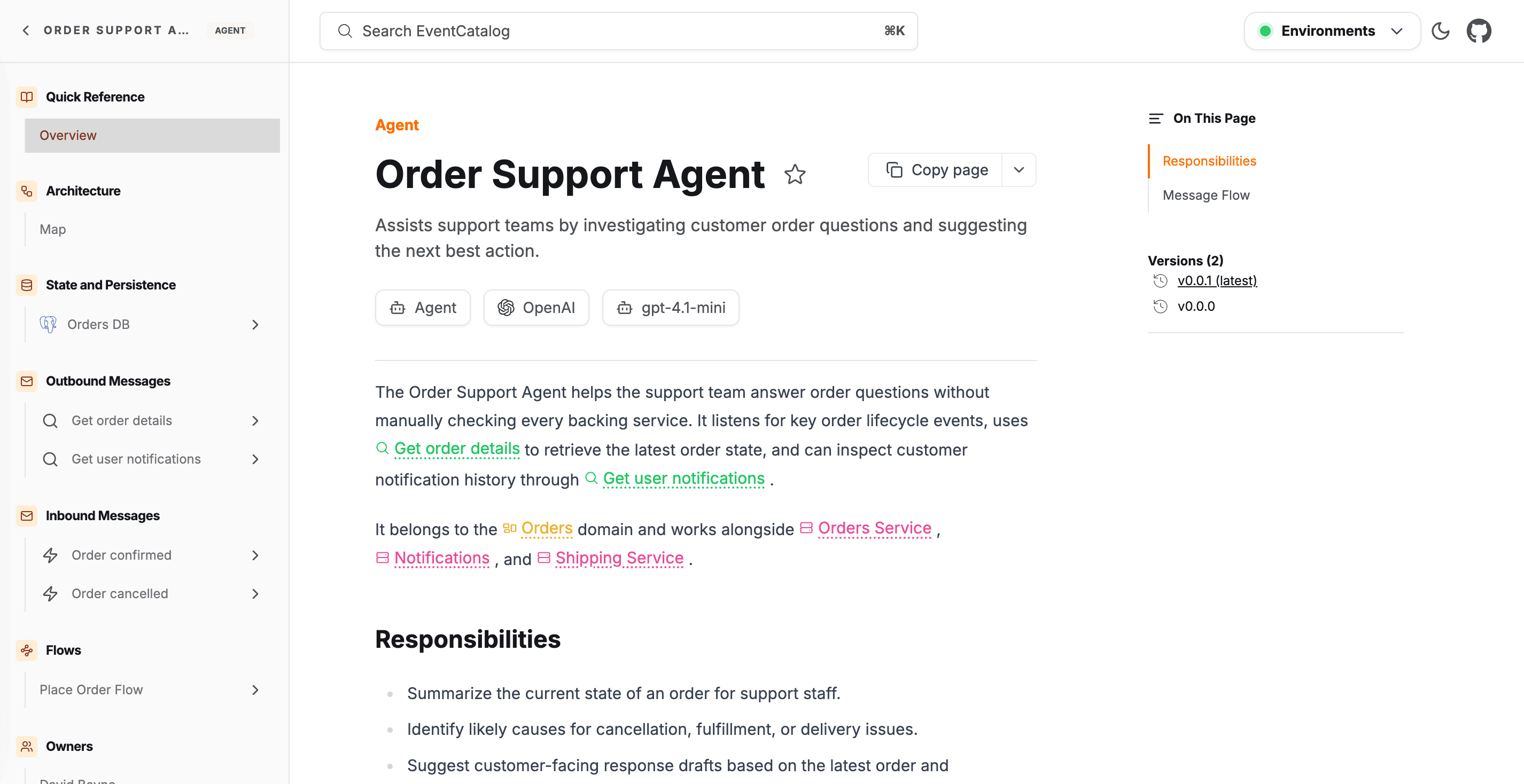
## Adding a new agent[](#adding-a-new-agent "Direct link to Adding a new agent")
### Automatic Creation[](#automatic-creation "Direct link to Automatic Creation")
Copy this prompt and paste it into your coding agent. Your agent can help you choose where the agent should live, create the right folder structure, and add the first version of the agent documentation.
### Manual Creation[](#manual-creation "Direct link to Manual Creation")
Agents can live at the root of your catalog or inside a domain.
Create a new folder for the agent with an `index.mdx` file.
* agents
/
* FraudReviewAgent
/
* index.mdx
If the agent belongs to a domain, keep it inside that domain:
* domains
/
* Payments
/
* agents
/
* FraudReviewAgent
/
* index.mdx
You can also place agents inside a subdomain when the agent belongs to a more specific business boundary.
## Create the agent file[](#create-the-agent-file "Direct link to Create the agent file")
Create an `index.mdx` file for the agent.
*Here is an example of what an agent markdown file may look like.*
/agents/FraudReviewAgent/index.mdx (example)
```
---
# id of your agent, used for slugs and references in EventCatalog.
id: FraudReviewAgent
# Display name of the Agent, rendered in EventCatalog
name: Fraud Review Agent
# Version of the Agent
version: 0.0.1
# Short summary of your Agent
summary: |
Reviews risky payments, explains fraud signals, and recommends whether payment processing should continue.
# Optional owners, references teams or users
owners:
- dboyne
# Optional model metadata describing the LLM this agent runs on
model:
provider: OpenAI
name: gpt-4.1
version: "2025-04-14"
# Optional external tools the agent can call
tools:
- name: Risk profile lookup
type: mcp
icon: /icons/tools/datadog.svg
url: https://mcp.example.com/fraud/risk-profile
description: Retrieves transaction anomaly, device fingerprint, and fraud model signals.
# Optional messages this agent receives and its version
receives:
- id: PaymentInitiated
version: 0.0.1
# Optional messages this agent sends and its version
sends:
- id: FraudReviewCompleted
version: 0.0.1
# Optional data stores this agent reads from
readsFrom:
- id: fraud-analytics-db
version: 0.0.1
# Optional badges, rendered to UI by EventCatalog
badges:
- content: AI Agent
backgroundColor: purple
textColor: purple
---
## Overview
The Fraud Review Agent reviews risky payment attempts before they continue through the payment gateway.
## Tools
```
## Attaching an agent to a domain[](#attaching-an-agent-to-a-domain "Direct link to Attaching an agent to a domain")
To associate an agent with a domain, add its `id` to the `agents` array in the domain's frontmatter:
/domains/Payment/index.mdx (example)
```
---
id: Payment
name: Payment Domain
version: 0.0.1
agents:
- id: FraudReviewAgent
version: 0.0.1
services:
- id: PaymentService
version: 0.0.1
---
```
EventCatalog will show the agent in the domain sidebar and include it in the domain visualiser.